To combat the dramatic spike in inflation following COVID, the United States Federal Reserve (the “Fed”) undertook an aggressive campaign of interest rate hikes beginning in 2022. By raising rates quickly, the Fed hoped to slow the economy, thereby fighting inflation. While effective at cooling inflation, this rate hike cycle also led to dislocations in the bond market and counterintuitive incentives for fixed income investors. For example, during much of the period from Spring 2023 until Fall 2025, investors could earn a higher yield by investing in cash than they could by buying longer-maturity bonds. Such a dynamic removed the term premium, or additional yield expected for loaning money over a longer period, that investors generally expect when investing in fixed income securities. It also allowed investors to reduce the amount of interest rate risk they needed to take to achieve attractive yields. Because of this, many investors have opted to maintain heavier-than-normal allocations to cash and cash-equivalent instruments for the past few years.
Recently, this situation has been reversing itself as the Fed began to lower interest rates and set the expectation that they will lower them further, though the future path of rates remains uncertain.
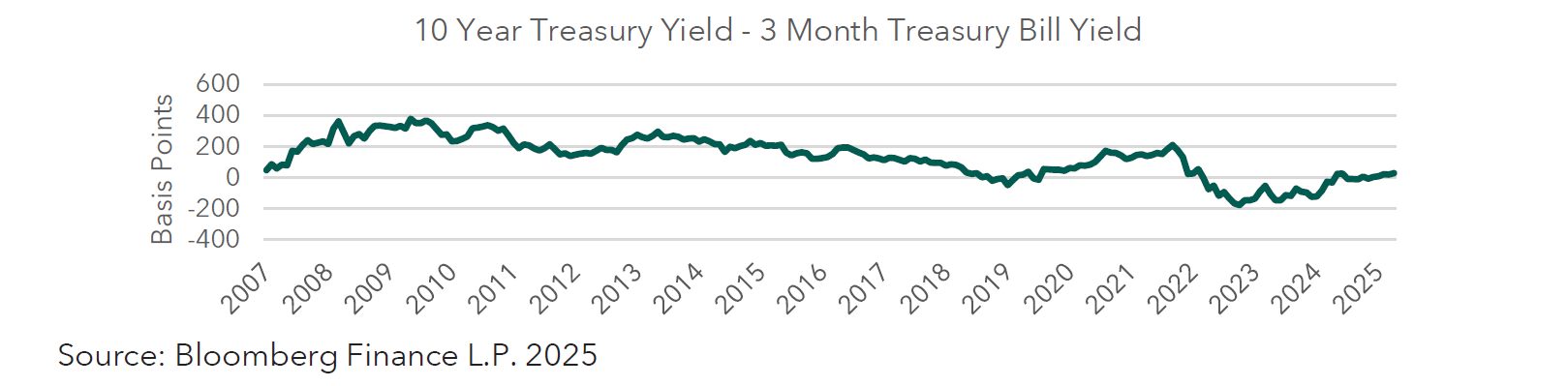
With the expectation that cash yields will continue to decline, investing in longer-maturity bonds now looks relatively attractive compared to recent history. As the above chart shows, 10-year yields are once again higher than those offered by T-Bills. Historically, T-Bill yields fall further and faster than intermediate term yields during Fed cutting cycles - a phenomenon referred to as bull steepening.
For cash investors (or those investing in cash-equivalent investments like T-Bills, Certificates of Deposit, or money market funds), rate cuts like the ones we anticipate today represent risk that investments will be reinvested at lower rates of return upon maturity. Locking in current yields for a longer period might behoove investors who are on a fixed income or looking to preserve more of their current spending power for longer as cash yields fall.
Further, we note that despite increasing duration, or the interest rate sensitivity of a portfolio of bonds, investors are insulated to a much greater degree from the risk of realizing losses in their bond portfolio because of higher starting yields. Said differently, when interest rates rise, bond prices fall. One risk of a longer-duration fixed income portfolio is that in a rising interest rate environment, the falling price of bonds may lead to negative returns. However, because investors can expect yields at fairly healthy levels in their portfolio, the total return expectations (price change + yield) only turns negative if rates rise over one full percent from current levels - a scenario our team believes is unlikely in this environment. Total return expectations depend on multiple factors and can be materially different from historical outcomes.
This dynamic can be seen in the below chart comparing the likely total return for intermediate bonds now relative to 2022, when starting yields were much lower. Additionally, if all rates were to fall from current levels, intermediate term bond prices would likely rise more than T-Bill prices. This is an important point, as it relates to returns in a falling interest rate environment; often times, rates are falling due to a weakening economy, which has at times coincided with falling stock prices. The ability to take gains from your bond portfolio in such an environment and rebalance them into equities at an opportune time is a valuable option investors should keep in mind.
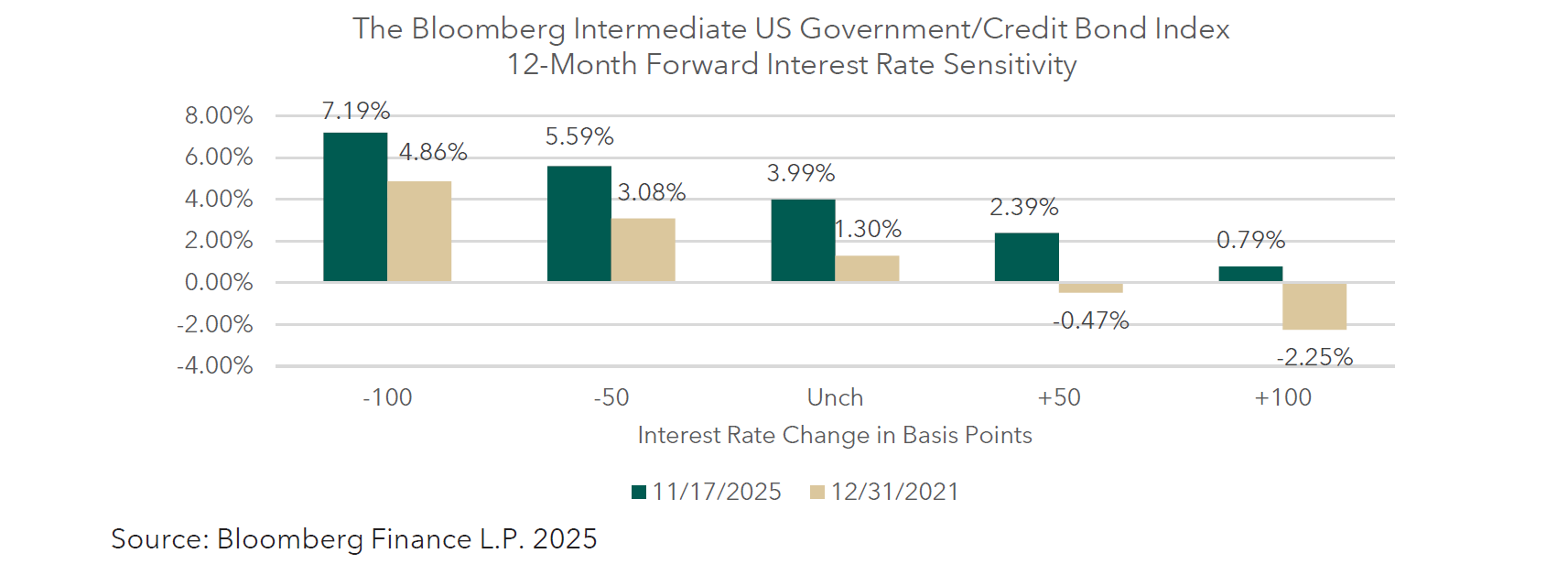
The chart above illustrates how changes in interest rates affect bond returns, highlighting the difference starting yields and coupons have on bond price movement. This example uses duration and convexity which are measures of bond price sensitivity to interest rate changes to illustrate potential return outcomes given starting yields. The data shown in the chart is for illustrative purposes only, has inherent limitations, and does not reflect actual investor experience. Actual results may differ materially.
Beyond the opportunity to lock in relatively attractive yields today by extending duration on cash and cash-like holdings, we also note the opportunity to manage fixed income assets with a total return focus. Actively managing bonds within a longer-duration portfolio can add incremental returns beyond those achieved just through the income generated from those instruments. Through the active selection of credits in the portfolio, structuring maturities of the portfolio to position for relative opportunities on the yield curve, and diversifying the types of credits and maturities thoughtfully, actively-managed bond portfolios have a number of tools available to generate returns in excess of just the yield they produce.
Today, cash yields look to be headed lower, calling into question how much longer investors can rely on the income they are currently receiving from short-term investments like cash, CDs, and T-bills. At the same time, intermediate bonds not only offer similar yields, but the potential for higher future returns over longer time horizons. Given this unique dynamic, our team believes now is an appropriate time to consider extending duration, and we believe doing so through an actively-managed approach positions clients best in a fast-changing rate environment.
Davidson Investment Advisors is a SEC registered investment advisor. The opinions expressed herein are those of Davidson Investment Advisors and are subject to change.
The information contained in this presentation has been taken from trade and statistical services and other sources, which we believe to be reliable. We do not guarantee that this information is accurate or complete and it should not be relied upon as such.
This presentation is for informational and illustrative purposes only and is not intended to meet the objectives or requirements of any specific individual or account. Past performance is not an indicator of future results. All investments involve risks. An investor should assess his/her own investment needs based on his/her own financial circumstances and investment objectives.